
Try something right now. Open ChatGPT and type: “Who are the best SEO Expert in Dubai ?”
Read the answer. Is your brand there?
For most UAE businesses, the answer is no, and the reasons have nothing to do with how good the business is. They have everything to do with how ChatGPT decides what to cite, and whether your brand has built the signals that make citation possible.
This guide is about changing that. Not through shortcuts or AI-specific hacks, but through the specific, buildable actions that make your brand the kind of source ChatGPT trusts enough to name.
First: understand what ChatGPT is actually doing when it answers
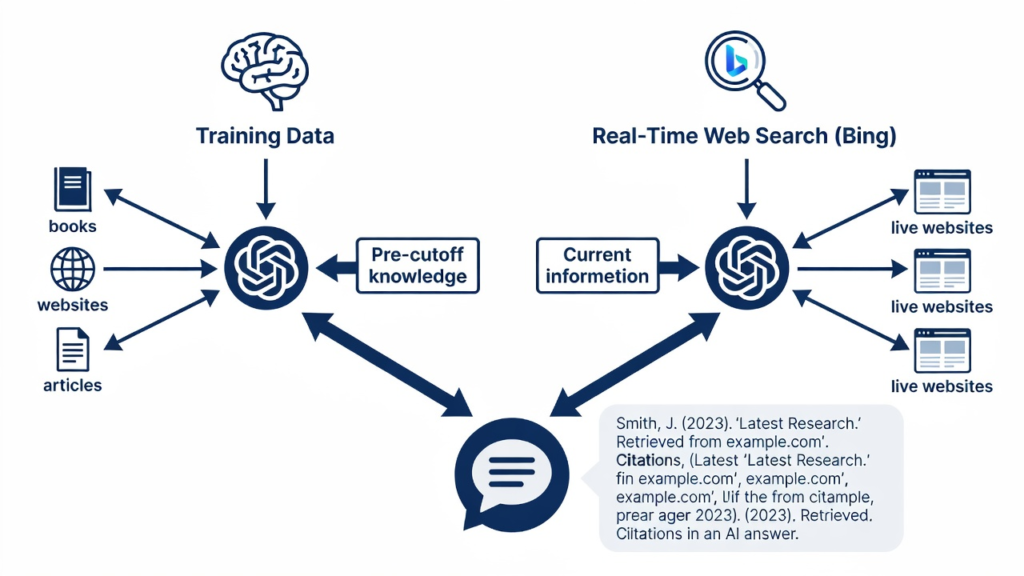
ChatGPT doesn’t search Google when it answers most queries. It draws from a training dataset, a vast corpus of text it was trained on, plus, in its web-browsing mode, real-time content it crawls through Bing. Understanding this distinction is fundamental to any citation strategy.
Training data citations come from content that existed before ChatGPT’s knowledge cutoff and was included in its training corpus. If your brand was consistently mentioned in credible, widely-referenced sources, industry publications, authoritative blogs, press coverage, Wikipedia, during that period, ChatGPT may cite you even without live search.
Real-time citations happen when a user has web browsing enabled or when ChatGPT searches during a conversation. In this mode, ChatGPT uses Bing to retrieve current information and cites the pages it pulls from. These citations are more predictable to influence because they follow patterns similar to traditional SEO — structured content, clear answers, authoritative pages.
Both matter. A brand that appears in training data and in current well-structured web content has the strongest citation position. That’s what a serious GEO strategy targets.
The signals ChatGPT uses to decide who to cite
No one outside OpenAI has the complete picture. But research from Princeton, Georgia Tech, and the Allen Institute for AI — the team that coined the term GEO, combined with observable citation patterns, points to a consistent set of signals.
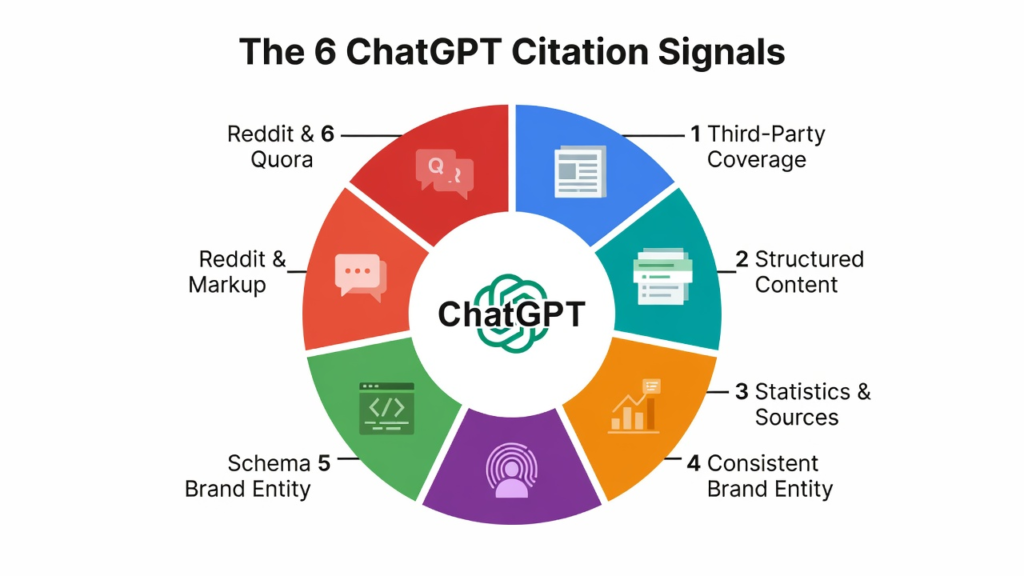
Corroborating mentions across multiple independent sources. ChatGPT consistently cites brands and claims that appear in multiple, unrelated sources rather than just one. If your brand is mentioned in five independent industry articles, a press release, two directory listings, and a guest post, ChatGPT is far more likely to recognize it as a real, established entity than if it only appears on your own website. This is the single most important citation signal.
Specificity and verifiability of claims. Vague claims get ignored. Specific, citable information gets pulled. “We’ve helped UAE businesses grow” is invisible. “Working with 40+ UAE businesses across the retail and hospitality sectors since 2019” is the kind of claim AI engines can extract, verify against corroborating sources, and cite. The more precise and checkable your brand’s stated facts, the more citable they become.
Content that directly answers the questions users ask. ChatGPT’s browsing mode looks for pages that answer questions in a clean, extractable format. Pages that open with a direct answer to a likely user query, “Who is the best SEO consultant in Dubai?” answered in the first paragraph, are structurally positioned for citation. This is why AEO (Answer Engine Optimization) and GEO share a significant amount of tactical overlap.
E-E-A-T signals: demonstrated expertise, not just claimed expertise. The difference between “I’m an expert in GEO” and “here’s the GEO framework I developed for a UAE retail client and the specific citation results 90 days later” is enormous from a credibility standpoint. AI models, trained on human text, have learned to distinguish between self-promotion and demonstrated knowledge. First-person case evidence, named client outcomes, and specific methodology descriptions consistently outperform generic authority claims.
Entity recognition. If Google’s Knowledge Graph recognizes your brand as a defined entity, with a Google Business Profile, consistent business information across directories, and ideally a knowledge panel, ChatGPT is more likely to treat your brand as a real-world object it can reference rather than just a sequence of words it has encountered. Entity establishment isn’t just an on-page SEO tactic. It feeds directly into AI citation probability.
What actually works: the citation-building actions
These are the specific moves that build ChatGPT citation probability. Not in order of importance, in the order I typically implement them for UAE clients.
Get your brand onto credible, indexed third-party sources
This is the foundation. Your own website can explain who you are, but ChatGPT doesn’t cite self-descriptions any more than a journalist does. You need coverage, mentions, and references from sources that exist independently of you.
The most accessible starting points for UAE service businesses:
Industry directories with genuine authority. Not every directory counts, ChatGPT is indifferent to low-quality link farms. The ones that matter are those that already appear in AI answers: Clutch, GoodFirms, DesignRush for service agencies; Google Business Profile and Yelp for local services; industry-specific associations. A verified listing on Clutch with real client reviews is worth more for citation probability than fifty directory submissions on sites nobody reads.
Press and media mentions. A single quote in Gulf News, Khaleej Times, or Arabian Business carries significant citation weight. Local UAE business media is undersaturated with genuine expert commentary, most publications are actively looking for credible local sources. A straightforward media outreach strategy, offering expert commentary on digital marketing trends in the UAE, can produce coverage within weeks.
Guest articles on authoritative publications. Writing for a recognized industry site, Search Engine Journal, SEMrush Blog, HubSpot, local UAE business publications, creates a corroborating source that ChatGPT can draw from. The article needs to include your name and brand clearly, and ideally include specific, citable claims about your work or methodology.
Podcast appearances. Podcast show notes are indexed by search engines and crawled by AI. An appearance on a credible UAE or regional marketing podcast, with a properly structured show notes page that includes your name, brand, and the topics covered, creates another independent citation source.
Build content that is structured for AI extraction
Every page on your website that you want ChatGPT to cite needs to be built around a specific question and answer it directly in the first paragraph. Not as a theoretical best practice, as a structural requirement.
The practical implementation: for each service or expertise area, write a page or blog post titled as the question a user would ask ChatGPT. Then answer it in the first 60 words. Completely. No preamble.
The rest of the page adds depth, evidence, and context. But the first paragraph is the extraction target. If ChatGPT is browsing and pulls your page, that first paragraph is what gets cited.
Pages on your site that currently don’t answer a question in the first paragraph, including most service pages, are structurally invisible to AI extraction regardless of how good the rest of the content is. This is the highest-leverage content restructuring work for GEO.
Use statistics and specific claims, with sources
Pages that include properly sourced, specific statistics get cited at significantly higher rates than pages with general assertions. This has been documented in GEO research and is consistent with observable ChatGPT citation behavior.
The practical implication: every piece of content you write that targets AI citation should include at least one specific, source-linked statistic relevant to the topic. Not as filler, as genuine evidence that supports your point and that ChatGPT can extract and verify.
If you don’t have your own data, cite established sources: industry research, government statistics, credible surveys. The citation pattern “according to [source], [specific number]” is among the most commonly extracted formats in AI-generated answers.
Make your brand name and expertise appear together, consistently
ChatGPT learns entity associations from repeated co-occurrence in text. If “Nazma Liaqat” and “SEO consultant Dubai” appear together consistently across your website, your social profiles, your directory listings, your guest posts, and your press coverage, the model builds a strong association between that name and that expertise.
Inconsistency undermines this. A brand described as “a digital marketing agency” in one place, “SEO and GEO specialists” in another, and “content and growth consultants” somewhere else is harder for a language model to classify and cite confidently. Consistent language across every surface, exact same description of what you do and who you serve, strengthens entity recognition.
Use schema markup to define your brand as an entity
Organization schema and Person schema on your website tell Google’s crawlers (and through them, AI engines trained on Google-indexed content) exactly what your business is, what it does, where it operates, and who leads it. This isn’t just an SEO tactic, it’s a direct input into the entity graph that feeds AI citation decisions.
At minimum, your homepage should have Organization schema with your business name, description, founding date, service area (Dubai, UAE, GCC), and links to your social profiles. If you work under your personal name, Person schema should include your name, job title, employer, and areas of expertise. This is one of the fastest-to-implement citation signals and one of the most consistently underused by UAE service businesses. Full implementation guidance is in the technical SEO services section.
Get mentioned on Reddit and Quora
This is counterintuitive for a lot of UAE business owners, but it’s important. Reddit and Quora are among the most heavily weighted sources in ChatGPT’s training data and real-time browsing. A thread on r/digitalnomad recommending a Dubai SEO consultant by name, or a Quora answer attributing a specific insight to a named UAE expert, creates citation source material that carries more weight than most branded content.
The ethical approach: participate genuinely. Answer questions in your area of expertise on Quora. Contribute to relevant subreddits as a practitioner, not a promoter. Your brand name appears naturally in the context of giving real value. Over time, these threads become citation sources that ChatGPT draws from, and you’ll often see your own Quora answers cited verbatim in AI responses if they’re specific enough and well-upvoted.
How long does it take to start getting cited?
Honest answer: it depends on where you’re starting from.
A brand with zero third-party mentions, no directory presence, and a website that doesn’t answer questions directly is starting from scratch. Realistically, building enough citation signal to appear in ChatGPT answers for competitive queries takes 90–120 days of consistent work.
A brand that already has some press coverage, a Google Business Profile, a few directory listings, and decent on-page content can often achieve first citations within 30–60 days of restructuring its content for AI extraction and adding schema markup.
The fastest wins almost always come from two places: content restructuring (rewriting existing pages to answer questions in the first paragraph) and adding authoritative third-party listings that ChatGPT already draws from (Clutch, GoodFirms, or relevant UAE-specific industry directories).
The slower but higher-impact work, building press coverage, creating guest content, establishing Reddit and Quora presence, compounds over 3–6 months and creates durable citation positions that are much harder for competitors to displace.
A note on ChatGPT’s different modes
Not every ChatGPT response is the same, and the citation strategy differs slightly by mode.
GPT-4 without browsing (the default for many users) draws purely from training data. Getting cited here requires having been in the training corpus — which means your brand needed to exist and be mentioned in indexed content before the training cutoff. You can’t directly influence past training data, but you can ensure your current content is positioned for future training cycles.
GPT-4 with browsing enabled (and ChatGPT’s search feature) pulls from Bing in real time. This is more directly influenceable. Bing-indexable content that answers questions clearly, is published on a credible domain, and includes your brand name prominently is your primary lever here. This is why fixing technical SEO issues ensuring ChatGPT’s crawler (GPTBot) can access your pages, is part of GEO, not separate from it.
Custom GPTs and enterprise deployments vary significantly. Some are connected to specific data sources. These are harder to influence generically and usually require direct relationship or content placement with the specific tool or platform.
For most UAE businesses, the priority should be GPT-4 with browsing, since this is both the most accessible to influence and the mode most users encounter when doing research queries.
The GPTBot question: is your site being crawled?
ChatGPT’s web crawler is called GPTBot. By default, it crawls publicly accessible pages. But many WordPress sites, particularly ones set up with aggressive SEO plugins, CDN security layers, or restrictive robots.txt configurations, accidentally block GPTBot.
Check your robots.txt file (visit yoursite.com/robots.txt). If you see User-agent: GPTBot followed by Disallow: /, you are explicitly blocking ChatGPT from crawling your site. That’s a direct citation blocker.
To allow GPTBot, you either need to remove that rule entirely or replace it with Allow: /. This is a five-minute fix with significant citation implications. While you’re there, also check for User-agent: PerplexityBot, User-agent: ClaudeBot, and User-agent: GoogleOther, these are the crawlers for Perplexity, Claude, and Google AI Overviews respectively. All of them should be allowed if you want AI citation access.
Tracking whether it’s working
Unlike traditional SEO, there’s no Search Console for AI citations. Measurement requires a different approach.
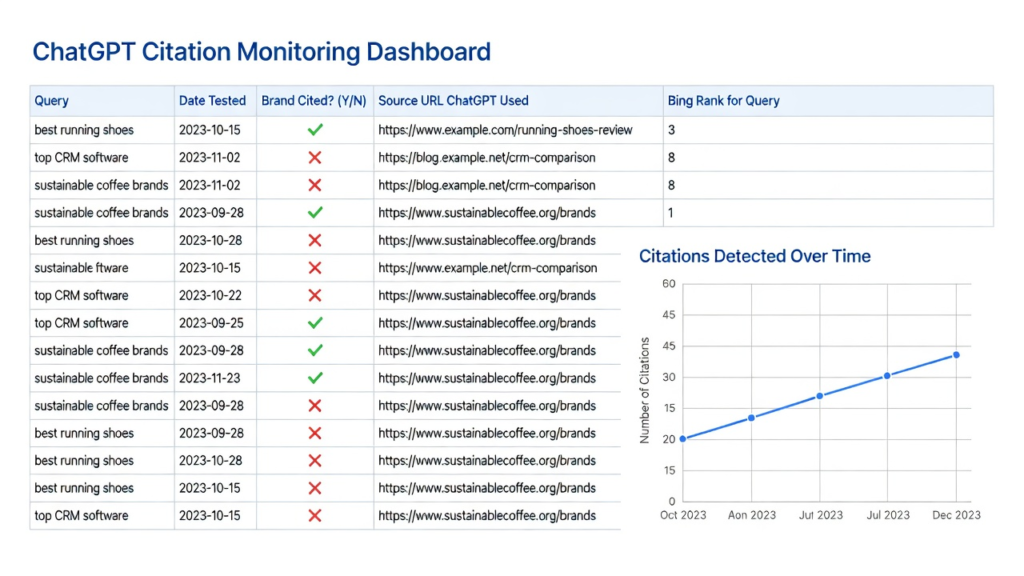
Direct ChatGPT testing. Monthly, open ChatGPT with browsing enabled and run 10–15 of your target queries: “best [your service] in Dubai,” “who are the top [your expertise] consultants in UAE,” “[specific question you want to be the answer to].” Note whether your brand appears, and if so, what source it cites. Screenshot and track over time.
Bing search visibility. Since GPT-4 with browsing uses Bing, your Bing search rankings are a direct proxy for ChatGPT browsing citations. Check Bing Webmaster Tools and track your rankings for target queries there in parallel with Google.
Brand mention monitoring. Set up Google Alerts for your brand name and personal name. New mentions in publications, forums, directories, and blogs are indicators that your citation footprint is growing, the same footprint ChatGPT draws from.
Perplexity testing. Perplexity AI consistently shows its sources inline. Searching your target queries on Perplexity tells you which sources AI engines are currently drawing from for those topics, useful competitive intelligence on what you need to displace.
Third-party tracking tools. Tools like Brandwatch, Mention, and specifically AI visibility tools like Profound or Goodie AI (emerging in 2026) are beginning to track AI citation rates more systematically. These are worth monitoring as the tooling matures.
Frequently Asked Questions
Can you pay ChatGPT to cite your brand? No. ChatGPT doesn’t accept payment for citations and has no advertising model that influences what it mentions in answers. Citations are earned entirely through the quality, reach, and credibility of your brand’s content and third-party mentions. This is what makes GEO a fundamentally different channel from paid search.
Does having a website automatically mean ChatGPT will cite you? Not at all. ChatGPT needs to be able to crawl your site (GPTBot must not be blocked), find answers to specific questions on your pages, and have corroborating evidence from other sources that your brand is a real, credible entity. A website alone, especially one that doesn’t answer questions directly in its content, contributes very little to citation probability.
Does ChatGPT use Google to find sources? No. When ChatGPT browses the web in real time, it uses Bing, not Google. This means your Google rankings don’t directly translate to ChatGPT citation visibility in browsing mode. Both search engines matter for GEO, but for different reasons, Google influences training data indirectly, while Bing drives real-time browsing citations.
How is getting cited by ChatGPT different from ranking on Google? Google ranks your page at a position in a list. ChatGPT names your brand inside a paragraph of text as a recommendation, example, or authority. The user experience is fundamentally different, a citation in a ChatGPT answer carries the implicit endorsement of the AI, which creates a different type of trust than a link in a ranked list.
What content format is most likely to get cited? Specific, question-answering content that opens with a direct answer in the first paragraph, includes verifiable statistics with sources, and is published on a domain with corroborating third-party mentions. Long-form, comprehensive content consistently outperforms thin content , but only if the structure makes the key answers easy to extract. Format and specificity matter as much as length.
Does my content language matter, Arabic vs English? For ChatGPT citations specifically, English-language content currently has much broader training representation and citation frequency. That said, Arabic-language content matters increasingly for Gemini and for Google AI Overviews serving Arabic queries. For UAE businesses targeting bilingual audiences, English content should be the primary GEO investment with Arabic as a secondary strategy.
What’s the difference between a brand mention and a brand citation? A brand mention is any reference to your brand name in any context. A citation is a reference where ChatGPT specifically names your brand as an answer to a user’s question, typically as a recommendation, authority, or source. Citations carry far more commercial value. The goal of GEO isn’t just mentions; it’s citations in response to queries with purchase intent.
Can my competitors get me removed from ChatGPT citations? No, ChatGPT doesn’t have a mechanism for removing or suppressing specific brands from its answers (outside of content policy violations). Your citation position is built on the quality and reach of your own signals. The way to lose a citation position is to stop maintaining and building your authority signals while competitors build theirs.
The honest reality about ChatGPT citations
There’s no code to crack here. ChatGPT doesn’t have an optimization target you can game, it has a training process and a browsing behaviour that consistently favour the same things: credibility, specificity, third-party corroboration, and content that answers questions directly.
The UAE businesses that will own AI citation positions in 2026 and 2027 are the ones building these signals now, methodically, before competitors realize the game has changed. The window for first-mover advantage in UAE GEO is genuinely narrow, six months from now, this will be a significantly more crowded space.
If you want to know specifically where your brand stands in AI citation visibility right now, which queries you appear for, which you should be appearing for, and what’s blocking you, my GEO services start with exactly that audit. Reach out through the contact page and I’ll run a citation assessment for your brand before our first conversation.
Read more in this series: