
Most SEO audits I’ve seen from UAE businesses fall into one of two categories: a 200-page automated report from a tool that nobody reads, or a four-slide PDF that calls itself an audit but is really just a sales pitch.
Neither is what a professional SEO audit should be.
A genuine audit answers a specific question: why isn’t this website performing the way it should, and exactly what needs to change? Everything in it should serve that question. If a section of the audit doesn’t lead to an actionable finding or a defensible decision, it doesn’t belong.
I’m Nazma Liaqat, an SEO consultant based in Dubai. I’ve audited sites ranging from small UAE service businesses to regional ecommerce operations with thousands of pages. What follows is the complete checklist I use, what each section covers, what it’s looking for, and what a weak audit typically misses.
The 7 components every professional SEO audit must cover
Before the checklist: a note on scope. Not every audit needs the same depth in every area. A 10-page local service site needs a different audit than a 50,000-product ecommerce store. But every professional audit, regardless of site size, should address all seven areas below. What varies is depth, not coverage.
1. Technical crawl and indexation
What it covers: Whether search engines can actually access, crawl, and index your pages, and whether the pages being indexed are the right ones.
This is always the first section because nothing else matters if Google can’t find your content. A page with perfect on-page SEO and strong backlinks that’s accidentally blocked by a robots.txt rule contributes nothing to your rankings.
What a professional audit checks here:
- robots.txt file are any important pages or directories blocked?
- XML sitemap does it exist, is it submitted to Google Search Console, does it contain only indexable pages?
- Crawl coverage, how many pages does Google know about versus how many the site actually has?
- Index bloat are there pages in the index that shouldn’t be (thin content, internal search results, duplicate URL variations)?
- Crawl errors, 404s, server errors, redirect chains that waste crawl budget
- Canonical tags are they implemented correctly and consistently?
- Pagination handling is it set up in a way that consolidates ranking signals rather than diluting them?
What a weak audit misses: The distinction between pages that are crawlable but not indexed, and pages that are both crawlable and indexed but shouldn’t be. Index bloat, having thousands of low-value pages indexed, is one of the most common and most underdiagnosed issues on UAE business sites, particularly those built on WordPress or Shopify with default settings.
For ecommerce sites especially, this section connects directly to the technical SEO work that typically produces the fastest ranking improvements.
2. Site architecture and internal linking
What it covers: How your pages are organised, how they link to each other, and whether that structure communicates your topical priorities to search engines.
Google doesn’t evaluate pages in isolation, it evaluates them within the context of the site they’re part of. A page about “SEO services in Dubai” ranks better when it’s supported by internal links from relevant cluster posts, pointed to by a logical navigation structure, and not buried five clicks deep from the homepage.
What a professional audit checks here:
- URL structure, is it logical, descriptive, and consistent?
- Navigation depth are important pages reachable within 3 clicks from the homepage?
- Internal link distribution are link signals flowing to the pages that need ranking support, or are they spread randomly?
- Orphan pages, pages with no internal links pointing to them (invisible to both users and search engines)
- Anchor text diversity, are internal links using meaningful, keyword-relevant anchor text or defaulting to “click here” and “read more”?
- Siloing and topical clustering, are related pages grouped and linked in a way that reinforces topical authority?
- Breadcrumb implementation, are breadcrumbs present and structured correctly?
What a weak audit misses: Orphan pages are almost always underreported. Most audit tools only find orphan pages within the crawled URL set, but if a page has no internal links, some crawlers never discover it in the first place, meaning it disappears from the audit entirely. A professional audit cross-references the crawl data against the sitemap and the Google Search Console index to catch pages that don’t appear in any of these places.
3. On-page SEO and content quality
What it covers: Whether individual pages are optimised for the right keywords, whether the content meets the quality bar Google expects, and whether the page signals align with user intent.
What a professional audit checks here:
- Title tags, unique, within character limits, keyword-relevant, compelling for click-through?
- Meta descriptions, written (not auto-generated), within limits, actionable?
- H1 and heading structure, one H1 per page, logical H2/H3 hierarchy, keyword alignment?
- Keyword targeting, is each page targeting a specific, realistic keyword? Is there keyword cannibalization (multiple pages targeting the same keyword and competing against each other)?
- Content depth, does the page cover the topic comprehensively enough to satisfy what a user searching that keyword actually needs?
- Content freshness, are dates, statistics, and references current?
- Thin content, pages under 300 words with no clear purpose
- Duplicate content, internal or external duplication that dilutes ranking signals
- Image optimization, alt text, file sizes, descriptive filenames
- Schema markup, is structured data present and correctly implemented? Are service pages, FAQs, and review content using appropriate schema types?
What a weak audit misses: Keyword cannibalization. I audit UAE websites regularly where three or four pages are all targeting the same primary keyword, competing against each other in Google’s index and collectively performing worse than a single well-optimized page would. Most automated audits don’t flag this because it requires intent analysis, not just crawl data.
This section links directly to on-page SEO services, the fixes here are often the highest-ROI changes a site can make because they require no new content or link building, just restructuring what already exists.
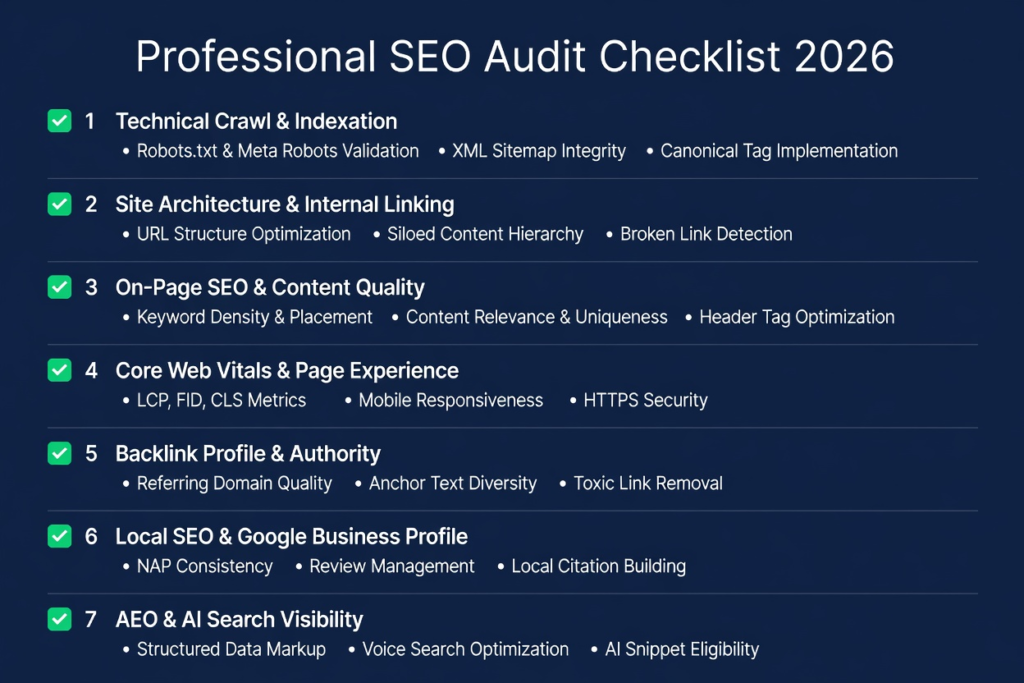
4. Core Web Vitals and page experience
What it covers: How fast your pages load, how stable they are visually, and how quickly they respond to user interaction, the signals Google groups under “page experience.”
Google made page experience an official ranking factor, and Core Web Vitals are the measurable component of that. For UAE businesses, this section of the audit frequently reveals issues that have been silently suppressing rankings for months without anyone noticing.
What a professional audit checks here:
- Largest Contentful Paint (LCP), how long until the main content is visible? Target: under 2.5 seconds
- Cumulative Layout Shift (CLS), does the page jump around as it loads? Target: under 0.1
- Interaction to Next Paint (INP), how quickly does the page respond to user input? Target: under 200ms
- Mobile vs desktop performance, does performance hold on mobile, where the majority of UAE users browse?
- HTTPS, is the site fully secured? Mixed content warnings?
- Intrusive interstitials, are popups blocking content in ways Google penalises?
- Image formats, are images served in next-gen formats (WebP, AVIF)?
- Render-blocking resources, is JavaScript or CSS delaying page rendering?
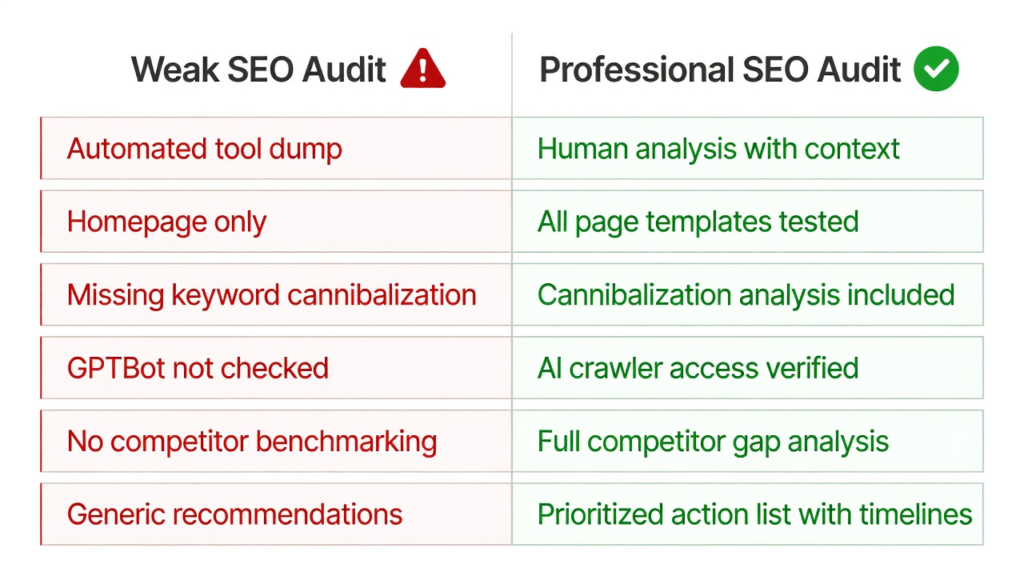
What a weak audit misses: Testing only the homepage. Core Web Vitals scores vary significantly by page template, a homepage might score well while every product page or blog post fails. A professional audit samples representative pages from each template type: homepage, service pages, blog posts, product/category pages (for ecommerce). For UAE ecommerce sites especially, category pages almost always have worse scores than the homepage and are almost never tested.
5. Backlink profile and off-page authority
What it covers: The quality, relevance, and diversity of websites linking to yours, the primary external signal Google uses to assess domain authority.
This section often surprises UAE business owners in two ways. Either they discover they have far fewer links than competitors they can’t outrank, or they discover links they didn’t know existed, sometimes from sources that are actively harmful to their rankings.
What a professional audit checks here:
- Total referring domains, raw link count matters less than the number of unique domains linking
- Domain authority distribution, are links coming from credible, relevant sites or from low-quality directories and link farms?
- Toxic and spammy links, links from penalised, irrelevant, or manipulative sources that may trigger algorithmic penalties
- Anchor text profile, is it natural and varied, or over-optimised with exact-match anchor text (a common black-hat footprint)?
- Link velocity, has the link profile grown steadily, or are there suspicious spikes that indicate bought links?
- Competitor benchmarking, how does your link profile compare to the top 3 competitors for your primary keyword?
- Link gap analysis, which credible sites link to your competitors but not to you? These are your highest-priority link acquisition targets
- Lost links, links that previously existed but have been removed, indicating opportunities for reclamation
What a weak audit misses: Anchor text over-optimisation. If 60% of your backlinks use exact-match anchor text like “SEO services Dubai,” that’s a pattern Google’s Penguin algorithm specifically penalises, and it usually came from old link-building campaigns the business owner has forgotten about or never knew existed. Most automated reports flag toxic domains but miss the anchor text distribution issue entirely.
This section connects to off-page SEO services and typically requires the most time to remediate because link building and disavowal work is slow by nature.
6. Local SEO and Google Business Profile
What it covers: How well the site and business are optimised for local search, particularly important for UAE businesses targeting customers in specific cities or areas.
For most Dubai and GCC service businesses, local search is where the majority of commercial-intent queries land. “SEO consultant Dubai,” “web designer Abu Dhabi,” “accountant near me in Sharjah”, these queries trigger Google’s local pack (the map results), and ranking there requires a different set of signals than ranking in regular organic results.
What a professional audit checks here:
- Google Business Profile completeness, all categories, services, hours, photos, description filled in?
- GBP verification status, is the profile claimed and verified?
- NAP consistency, is the business name, address, and phone number identical across the website, GBP, and all directory listings? Even small variations (St. vs Street, +971 vs 00971) can create conflicting signals
- Local citation coverage, is the business listed in the key UAE directories that Google uses as authority signals?
- Review profile, review count, recency, and response rate (all ranking factors for local pack)
- Location pages, for businesses serving multiple UAE cities, are there dedicated, well-optimised pages for each service area?
- Local schema, LocalBusiness schema correctly implemented?
- Google Maps embedding, is the location properly embedded on the contact page?
What a weak audit misses: NAP inconsistency across third-party directories. It’s remarkably common for UAE businesses to have their business name spelled slightly differently across Clutch, Yellow Pages UAE, Gulf Business, and their own website and to have different phone numbers listed from previous business setups. This inconsistency tells Google the business isn’t clearly defined as a local entity, which directly suppresses local pack rankings.
This section is the foundation of local SEO services, and for most UAE service businesses, it’s the fastest path to ranking improvements because local signals change faster than organic ones.
7. AEO and AI search visibility
What it covers: Whether the site is positioned to appear in featured snippets, “People Also Ask” boxes, voice search responses, Google AI Overviews, and AI engine citations from ChatGPT and Perplexity.
This section didn’t exist in a professional SEO audit three years ago. It does now. As of 2026, more than half of Google searches end without a click, the user gets their answer from an AI-generated summary or answer box without visiting any website. If your site isn’t structured to feed those surfaces, a significant portion of your potential visibility is going to competitors who are.
What a professional audit checks here:
- Featured snippet presence, does the site currently hold any position zero results? Which queries are close to winning?
- FAQPage schema, is it implemented on service pages and blog posts? Does it match visible page content?
- Question-answer content structure, are key pages structured with question headings and direct answers in the first paragraph?
- “People Also Ask” gap analysis, which PAA questions appear for target keywords that the site doesn’t currently answer?
- AI crawler access, are GPTBot (ChatGPT), PerplexityBot, ClaudeBot, and GoogleOther allowed in robots.txt?
- AI citation presence, does the brand currently appear when target queries are asked to ChatGPT or Perplexity?
- Voice search readiness, is content written in conversational language appropriate for voice query responses?
- Google AI Overview citations, does the site appear in AI Overview citation panels for relevant queries?
What a weak audit misses: AI crawler blocking. A surprising number of UAE business sites, particularly those set up with aggressive security configurations or certain Cloudflare settings, have robots.txt rules that explicitly block GPTBot and PerplexityBot. The site owner has no idea because it has no effect on Google rankings. But it means the site is completely invisible to ChatGPT’s browsing mode and Perplexity, both of which are increasingly primary research tools for UAE business decision-makers.
This section connects to both AEO services and GEO services, and for UAE businesses, it represents the largest gap between current optimization and what the competitive landscape will demand in the next 12 months.
What a professional audit deliverable looks like
The seven-section checklist above is the content of the audit. The deliverable is how that content gets communicated, and this is where many agencies fall short even when the analysis itself is solid.
A professional SEO audit report should include:
An executive summary. Two pages maximum. What are the three to five most critical issues found? What is their estimated impact on rankings if fixed? What’s the recommended order of attack? A business owner or marketing manager should be able to read the executive summary and understand the site’s situation without reading the full report.
Prioritized findings, not alphabetical lists. Issues should be ranked by impact and effort. A crawlability issue blocking 200 pages from Google is priority one. A missing alt tag on a blog image from 2019 is not. Most automated reports present findings alphabetically or by category with no prioritization, which means the client doesn’t know where to start.
Specific, actionable recommendations. “Improve your content quality” is not a recommendation. “The /services/seo-audit/ page targets ‘SEO audit Dubai’ but opens with a paragraph about your company history rather than a direct answer to what an SEO audit is, restructure the first 100 words to answer that question directly” is a recommendation.
Competitor context. Your site’s metrics only mean something relative to what you’re competing against. A domain rating of 18 might be fine if your top competitor has a domain rating of 12, or it might be a serious gap if they have a domain rating of 45. A professional audit includes benchmark data for the top three competitors on your primary keywords.
Implementation guidance. A good audit is useless if the client can’t act on it. For each major finding, the report should indicate who needs to make the change (developer, content writer, SEO specialist), how long it typically takes, and what tool or method to use.
How to use this checklist when evaluating an SEO consultant
If you’re shopping for an SEO audit in Dubai or the wider UAE, this checklist is your benchmark. Before hiring anyone, ask them directly: does your audit cover all seven areas above?
Specifically, ask about:
- Do you check AI crawler access (GPTBot, PerplexityBot)?
- Do you include AEO and featured snippet analysis?
- Do you benchmark against competitors, not just look at my site in isolation?
- Does the report include a prioritized action list or just a list of issues?
- Do you test Core Web Vitals across multiple page templates, not just the homepage?
If the answers are vague or if they’ve never heard of GPTBot, that tells you something important about how current their methodology is.
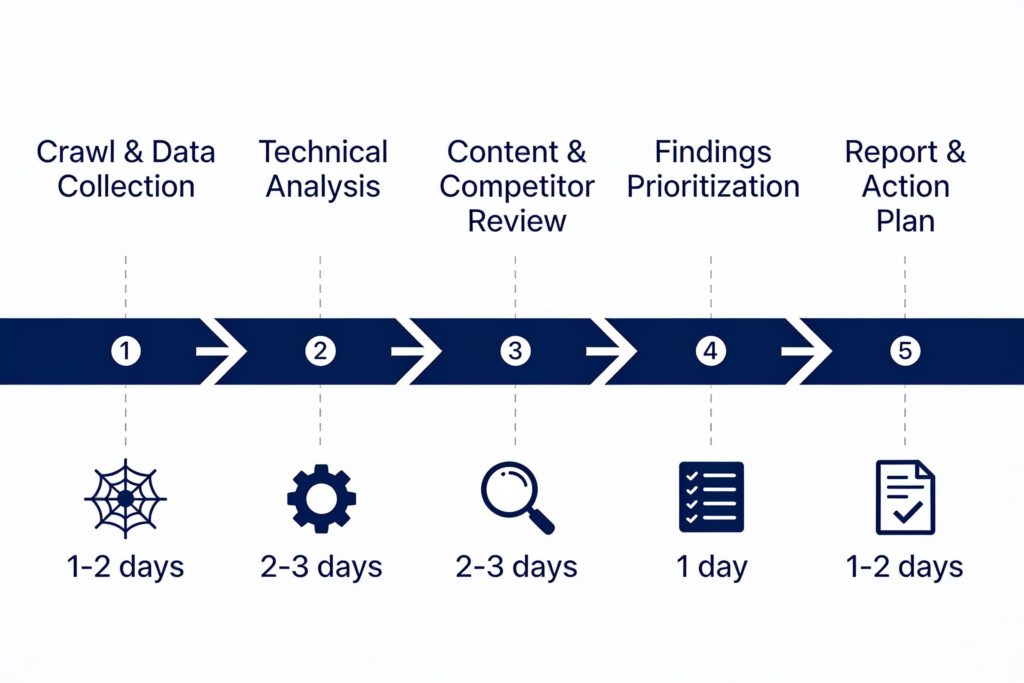
A professional SEO audit in the UAE typically takes 5–10 business days to complete properly for a small-to-medium site, and the deliverable should run 30–60 pages of actual analysis, not tool screenshots. If someone offers you a same-day audit or a 5-page PDF, you know what category it falls into.
Frequently Asked Questions
What is the most important part of an SEO audit? The technical crawl and indexation check always comes first, if Google can’t properly access and index your pages, nothing else in the audit matters. After that, the priority depends on the site. For a new site with few links, on-page SEO and content quality usually have the highest impact. For an established site that’s lost rankings, the backlink profile and technical health sections tend to reveal the most.
How long should a professional SEO audit take? For a small-to-medium UAE business website (under 500 pages), a thorough professional audit takes 5–10 business days from start to deliverable. Faster than that, and the analyst hasn’t had time to do manual analysis beyond tool outputs. For larger sites, ecommerce stores with thousands of pages, expect 2–4 weeks.
What tools are used in a professional SEO audit? A complete audit typically uses: Google Search Console and Google Analytics (first-party data), Screaming Frog or Sitebulb (technical crawl), Semrush or Ahrefs (keyword and backlink data), PageSpeed Insights or Lighthouse (Core Web Vitals), and manual browser inspection. No single tool covers everything, audits that rely on just one platform miss significant issues.
What’s the difference between a free SEO audit and a paid one? A free audit, including automated reports from tools or quick assessments agencies use as lead magnets, can identify surface-level technical issues but rarely includes competitor benchmarking, intent analysis, AI visibility assessment, or prioritized recommendations. A paid professional audit is manual analysis that interprets what the data means for your specific business situation.
Should I get an SEO audit before or after building a new website? Both. An audit before a website redesign or rebuild prevents you from repeating existing mistakes and documents what’s working (so you don’t accidentally remove it). An audit after the launch verifies that the new site was implemented correctly and that nothing was lost in the transition. Many UAE businesses lose significant rankings during site migrations because the SEO wasn’t considered until after the new site went live.
Does an SEO audit include keyword research? A professional audit includes analysis of your current keyword targeting, whether you’re targeting the right keywords, whether there’s cannibalization, and how your target keywords compare to competitors. It may not include a full standalone keyword research project. If you’re building a content strategy from scratch, that’s typically a separate deliverable.
How often should a UAE business get an SEO audit? For most businesses: a comprehensive audit annually, with lighter quarterly reviews. If you’ve recently launched a new site, changed platforms, experienced a significant traffic drop, or are about to invest in a major SEO campaign, those are additional triggers for a full audit regardless of timing.
What should I do after receiving an SEO audit? Start with the high-impact, low-effort fixes identified in the executive summary, these typically include technical issues like crawl errors, canonical problems, and missing schema markup. Then move to content restructuring and on-page optimization. Link building and authority work comes last because it takes longer to show results. A good audit report should sequence this for you explicitly.
The audit is the starting point, not the destination
An SEO audit is worth exactly as much as what gets done with it. I’ve seen businesses sit on comprehensive audit reports for six months while competitors who received a simpler audit and acted on it immediately have taken their rankings.
The value isn’t in the document. It’s in the prioritized list of changes, the implementation that follows, and the monitoring that tells you which changes moved the needle.
If you’d like to see what a professional SEO audit actually looks like for a UAE business, including the AEO and AI visibility components most audits skip, I offer a free initial audit that covers the high-level findings across all seven areas. It’s a starting point for a real conversation, not a sales pitch dressed up as analysis.
Related reading: