
Let me start with something that might change how you look at your Google Analytics.
Open Search Console right now and look at your impressions versus your clicks. For most UAE business websites I audit, there’s a gap, sometimes a massive one. Pages getting 2,000 impressions a month and only 80 clicks. That’s not a ranking problem. That’s an AEO problem.
Answer Engine Optimization is the reason that gap exists, and understanding it is the reason some of your competitors are getting visibility you’re not, even when they rank below you.
So what exactly is AEO?
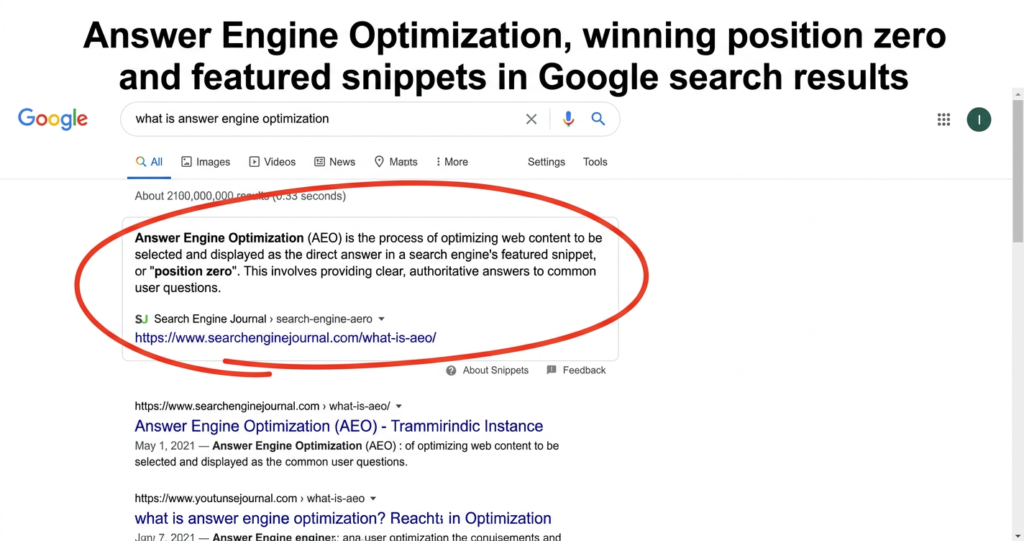
“Answer Engine Optimization (AEO) is the practice of structuring your content so Google can pull a direct answer from your page and display it above the regular search results, in a featured snippet, a “People Also Ask” box, or a voice search response, without the user needing to click through.“
You’ve seen these your whole career. The box at the top of Google with a paragraph answer and a source link. The expandable questions that appear mid-results. The thing Siri reads out when someone asks their phone a question. Those are all AEO real estate, and they have their own rules, completely separate from traditional ranking.
The distinction matters because a page ranked #4 can win position zero. A page ranked #1 can lose it entirely. Rank and answer visibility are not the same thing.
The number that reframes everything
58.5% of Google searches end without a click, according to SparkToro’s 2024 zero-click study.
More than half. No click, no visit, no chance to convert.
Those users aren’t disappearing, they’re getting their answer directly from Google’s interface. Featured snippets, AI Overviews, PAA boxes. If your content is structured to feed those surfaces, you’re the brand they see and remember. If it’s not, they leave having never heard of you.
For a Dubai business spending money on SEO to rank in the top 5, this should be an uncomfortable number. It means ranking is increasingly just the table stakes. Answer visibility is where the attention actually goes.
What Google is actually doing when it builds an answer box
Most people think of Google as returning a list of links. That’s still true, but it’s only part of what’s happening now.
When a user types a question, particularly a “what is,” “how to,” “best way to,” or “how much does” query, Google runs a secondary analysis on top of its ranking algorithm. It looks across the top-ranked pages and asks: which of these pages gives me the clearest, most extractable answer to this specific question?
That’s not the same as which page has the best backlinks, or the most comprehensive content, or the highest domain authority. It’s asking which page is formatted to be cited.
This is the core insight behind AEO. Google isn’t just reading your content, it’s trying to pull from it. Pages that make that extraction easy win. Pages that don’t, don’t.
The specific things Google looks for:
A direct answer in the first sentence after a question heading. Not a preamble. Not context-setting. The answer, immediately. If your H2 says “What is a featured snippet?” and your first sentence says “Featured snippets are a fascinating and complex part of Google’s search ecosystem that many businesses are starting to pay attention to”, Google moves on. If it says “A featured snippet is a selected search result that Google displays in a box at the top of results to directly answer a user’s query”, that’s what gets extracted.
A question formatted as an actual heading. H2 or H3, phrased the way a user would type it. This signals to Google that the content beneath it is specifically answering that question.
FAQPage schema markup. Structured data that tells Google’s crawlers: here are the questions on this page, and here are the exact answers. Pages with correct FAQPage schema have a significantly higher chance of appearing in rich results and featured snippet consideration.
Conversational phrasing. Voice search pulls from featured snippets, and voice queries sound different from typed ones. “What’s the best SEO consultant in Dubai” is a voice query. Content that answers questions in natural, spoken-language style performs better across both surfaces.
Topical depth around the question. A standalone page answering one question cold performs worse than the same page sitting inside a site with multiple supporting pages on the same topic. This is the pillar-cluster model working directly in service of AEO.
The five places AEO actually shows up
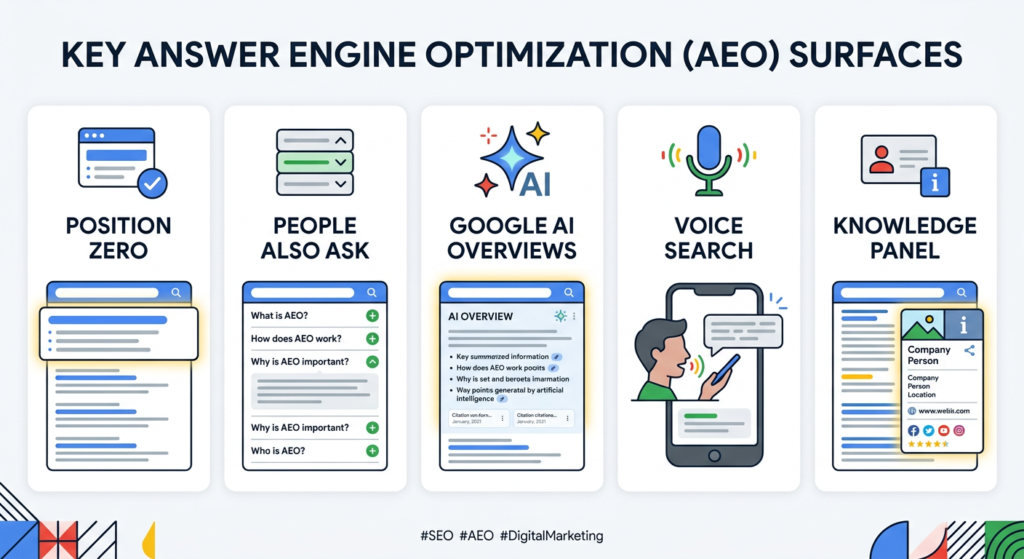
AEO isn’t one thing. It’s five distinct surfaces, each with slightly different mechanics.
Position zero, the featured snippet. The boxed answer at the very top of the results page, above all organic blue links. Google chooses between three formats depending on what the query needs: a paragraph (for “what is” and “how does” questions), a numbered list (for “how to” steps), or a table (for comparisons). You can’t choose which format you get, but you can structure content in all three formats and let Google pick.
People Also Ask. The accordion section that appears mid-SERP, often after the first two or three organic results. Each PAA entry is a question; expanding it shows a short paragraph answer pulled from a specific page. What’s powerful about PAA is that it’s self-generating: clicking any answer expands additional related questions, potentially infinitely. A single well-optimized page can appear in dozens of PAA boxes across different queries.
Google AI Overviews. Google’s AI-generated summaries that now appear at the top of results for a growing range of queries. Unlike featured snippets (which cite one source), AI Overviews synthesize from multiple pages simultaneously, each with a visible citation link. Getting cited in an AI Overview drives referral traffic without requiring a top organic ranking. For UAE businesses, local query AI Overviews often cite thin or generic content that a properly structured local page can displace. This surface also overlaps with GEO (Generative Engine Optimization), a closely related strategy worth reading alongside this one.
Voice search responses. Everything Siri, Google Assistant, and Alexa read aloud comes from a featured snippet or knowledge panel. Voice queries are longer and more conversational than typed queries: “where can I find a good SEO consultant in Dubai” rather than “SEO consultant Dubai.” Voice-optimized content uses natural sentence structure and answers local variations of queries.
Knowledge panels. The branded information box on the right side of Google results, showing structured data about your business: name, description, services, reviews, images. Knowledge panels are fed by Google’s Knowledge Graph, which pulls from schema markup, Google Business Profile, Wikipedia/Wikidata, and consistent brand data across the web. For service businesses in Dubai, a verified knowledge panel is a trust signal that reinforces every other piece of content on your site.
AEO and SEO: not the same optimization, not competing goals
Here’s where I see UAE businesses get confused, usually by consultants who present AEO as either identical to SEO or as a replacement for it. It’s neither.
| Traditional SEO | AEO | |
|---|---|---|
| What you’re ranking for | A position in the blue links | A spot inside Google’s answer surfaces |
| Primary signals | Backlinks, keywords, technical health | Content structure, schema, direct answers |
| Position target | #1–#10 | Position zero, PAA, AI Overview |
| Does it require a click? | Yes | Often no |
| Time to early results | 6–12 months for competitive terms | 4–8 weeks after content restructuring |
| Measured by | Rankings, organic traffic | Featured snippet wins, PAA appearances, CTR changes |
The relationship between them matters more than the differences. AEO without a solid technical SEO foundation doesn’t work — Google needs to trust and crawl your site before it’ll extract answers from it. But SEO without AEO leaves answer box real estate on the table for competitors to take, often from lower-ranked pages.
The practical implication: if you’re already investing in SEO services, adding AEO isn’t starting over. It’s restructuring content you already have, adding schema to pages that already rank, and answering questions more directly than you currently are. The lift is smaller than most people expect.
Why this is the right moment for UAE businesses specifically
I want to be specific here rather than generic, because the UAE market has a few characteristics that make AEO genuinely more accessible right now than it would be for a business in London or New York.
Competition for featured snippets on Dubai-specific service queries is thin. Search “how much does SEO cost in Dubai,” “what is digital marketing Dubai,” or “best local SEO services UAE” and look at who’s winning position zero. In most cases, it’s either a generic global article with no local context, or a directory listing. These are positions a well-structured local page can take within weeks, not months, because the content competing for them is weak.
Mobile search rates in UAE are among the highest globally. Mobile users both type shorter queries and use voice search more frequently than desktop users. Both of those behaviours favour AEO-optimized content. If your site isn’t built to feed those surfaces, you’re invisible to a significant portion of how UAE users actually search.
Arabic-English bilingual search behaviour creates PAA opportunities that most businesses miss entirely. When users switch between Arabic and English mid-research, which happens constantly in UAE, the PAA boxes that generate are often completely unclaimed. A business that answers questions in both languages has double the PAA surface to compete for.
What good AEO implementation actually looks like
This is what I do when I’m restructuring a UAE business site for AEO. Not a generalised list of tactics, the actual sequence.
Starting point: find what’s already close. Run your site in Google Search Console and filter by average position 2–10. These pages are already trusted enough that Google considers them for answer boxes, they just haven’t won them yet. These are the highest-leverage restructuring targets because Google’s opinion of the page is already positive.
The content restructure. For each target page: identify the primary question the page answers, rewrite it as an H2 heading phrased as a user would type it, and write a 40–60 word direct answer as the very first paragraph beneath that heading. Not context. Not a definition of terms. The answer. Then add supporting detail below. Repeat for every major subtopic on the page.
Schema implementation. Add FAQPage schema to every service page and key blog post. Rank Math’s schema builder does this without touching code. Each FAQ item needs to match a visible question-answer pair on the page, Google penalises schema that doesn’t correspond to actual page content. Submit the updated sitemap to Google Search Console and Bing Webmaster Tools after implementing.
HowTo schema for process content. Any page that walks through a process, “how to set up Google Business Profile,” “how to do a keyword audit,” “how to optimize a product page”, should have HowTo schema marking up each step. Google can display these as expandable step-by-step results directly in the SERP.
Voice and local query targeting. Add a section to each service page that directly answers the most common local voice query for that service. For an SEO consultancy in Dubai: “Who is the best SEO consultant in Dubai?” answered in 50 words, conversationally, in the first person. Same pattern across every service page.
Entity establishment for knowledge panels. Add Organization and Person schema to your site. Ensure your Google Business Profile is claimed, verified, and fully populated. Maintain consistent NAP (name, address, phone) data across all UAE local directories. These steps are the prerequisite for knowledge panel eligibility, Google needs to recognize your brand as a defined entity before it’ll display one. This also supports your broader GEO strategy, since entity recognition feeds AI engine citations too.
The mistakes that waste AEO effort
I’ve audited enough UAE websites to know what breaks AEO before it starts. These are the most common.
Schema that doesn’t match visible content. Adding FAQPage schema to a page that has no FAQ section. Google detects this, ignores the schema, and may flag the page for a manual review. The rule is simple: your schema should describe what’s actually on the page.
Hedged opening sentences. “The concept of AEO is something that has been discussed quite a lot recently in SEO circles and there are different perspectives on what it means.” That sentence will never win a featured snippet. The first sentence after a question heading needs to be the answer, not a warm-up.
Optimizing only for “what is” queries. Informational queries are the easiest AEO targets, but commercial queries, “best SEO service Dubai,” “how much does X cost in UAE,” “X vs Y for Dubai businesses”, also have featured snippets, and they carry far more purchase intent. Balance both.
Ignoring the PAA box as a content research tool. The “People Also Ask” section on any Google results page is a live map of what your audience wants answered. I use it as my primary content planning source for on-page SEO and AEO alike: search a target keyword, screenshot every PAA question, and build content to answer each one directly. Most UAE businesses don’t do this.
Disconnecting AEO from the technical foundation. A page with correct FAQPage schema, great answer structure, and solid content, sitting on a site with Core Web Vitals failures, slow load times, and crawl errors, will underperform. Technical SEO is the prerequisite. Google weights technical health before it even considers answer box eligibility.
Measuring whether AEO is working
AEO measurement is different from rank tracking. You’re not looking for position movements, you’re looking for answer box appearances.
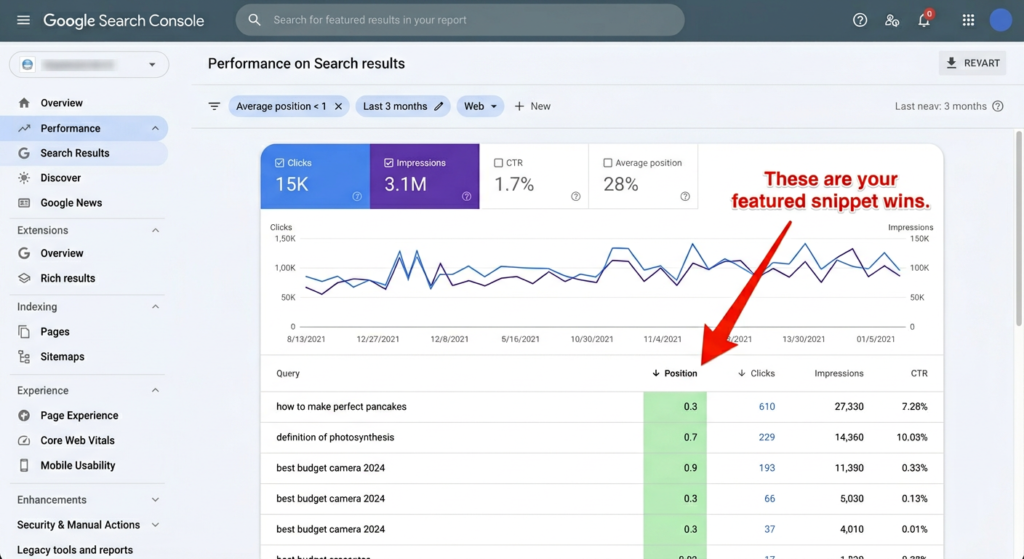
Google Search Console, filtered by position 0. Export your queries and filter by average position below 1.0. These are featured snippet appearances. Track the count over time, growth here is the primary AEO success signal.
Manual PAA monitoring. Monthly, search your 20 most important target queries and note which PAA boxes exist and whether your site appears in any. Tools like Semrush and Ahrefs can automate some of this tracking.
Google Rich Results Test. After implementing schema, run each key page through Google’s Rich Results Test. Confirm the schema is valid and the page is eligible for rich result display. Any errors here mean the schema won’t work regardless of how good the content is.
CTR changes for existing rankings. When a page wins a featured snippet, its click-through rate typically rises 20–35% even if its rank position stays flat. Watch for CTR improvements on specific queries in Search Console — these often signal a snippet win before the position data updates.
Voice search spot-testing. Once a month, manually test your top 10 target queries using Google Assistant and Siri. Document what gets read aloud and whether it’s your content.
AI Overview citations. Search your primary keywords on Google and check whether your brand appears in any AI Overview citations. If you want to go deeper on this, it connects directly to GEO tracking methodology, the two measurement approaches overlap significantly.
Frequently Asked Questions
What does AEO stand for? AEO stands for Answer Engine Optimization, the practice of structuring content so Google can extract direct answers and display them in featured snippets, People Also Ask boxes, voice search responses, and AI Overviews, without the user clicking through to your site.
Is AEO the same as SEO? Related, but not the same. SEO optimizes for ranking in the blue-link results. AEO optimizes for appearing in the answer surfaces that sit above those results. The two are complementary, AEO works better on sites with a strong SEO foundation, but the specific tactics differ.
Is AEO the same as GEO? Overlapping but distinct. AEO focuses on answer surfaces within traditional search engines: featured snippets, PAA boxes, voice responses, AI Overviews. GEO (Generative Engine Optimization) focuses on being cited inside fully AI-generated answers from ChatGPT, Perplexity, Gemini, and Claude. Strong AEO directly supports GEO, the content structures and schema that win answer boxes also make content more citable by AI engines.
How quickly can AEO show results? Restructuring an existing page that already ranks in positions 2–10 can produce a featured snippet win within 4–8 weeks. New pages on new topics take longer, they need to earn ranking consideration before they’re eligible for answer boxes. Schema implementation alone (without content changes) rarely moves the needle; the content structure matters more.
What is position zero? The featured snippet that appears above Google’s #1 organic result. “Position zero” because it sits outside the standard 1–10 ranking. It’s the primary AEO target, a page ranked #4 can win it, and a page ranked #1 can lose it if their content structure is weaker.
Do I need to abandon traditional SEO to focus on AEO? No, and you shouldn’t. AEO depends on the technical health, content quality, and crawlability that good SEO builds. Think of AEO as the layer that extracts additional visibility from your existing SEO investment, not a replacement for it.
Does AEO work for local Dubai service businesses? Particularly well. Featured snippet competition for Dubai-specific queries is thin, most position zero results for local service queries are currently held by generic global content. A locally-focused, properly structured page can displace these within weeks. Pair it with strong local SEO and the compounding effect is significant.
What schema type matters most for AEO? FAQPage schema, by a clear margin. It explicitly identifies question-answer pairs to Google’s crawlers. HowTo schema is the second priority for process content. Organization and Person schema matter for knowledge panel eligibility, a separate but related AEO goal.
Can a small UAE business do AEO without hiring an agency? Yes, the core work (restructuring content around questions, implementing FAQPage schema via Rank Math) doesn’t require technical skills or agency support. The areas where expertise helps most are competitive gap analysis and ongoing measurement. If you want a head start, my AEO services cover exactly that.
How do I know if my pages are winning featured snippets? Google Search Console shows featured snippet appearances as queries with an average position below 1.0. Filter your queries report by this metric, any query averaging position 0.x is a featured snippet win. Track this count monthly.
One thing I want to leave you with
AEO isn’t a new channel to add to your marketing stack. It’s a different way of structuring content you’re already creating.
The UAE businesses I see winning answer boxes aren’t publishing more content than everyone else. They’re publishing content that’s built to be extracted, direct answers at the top, questions as headings, schema that maps the structure to Google explicitly.
If you’ve been creating content for years and your featured snippet count in Search Console is zero, the content isn’t the problem. The structure is. And structure is fixable faster than most SEO problems.
If you want a clear picture of where your site’s AEO opportunities are, which queries you’re close to winning, which pages need restructuring, what schema is missing, that’s exactly what I cover in my free SEO audit. It’s not a generic report. It’s a specific look at your site’s answer visibility alongside traditional rankings.