
If you’re running a business in Dubai, Abu Dhabi, or anywhere across the GCC, here’s something worth knowing: your potential customers are increasingly asking ChatGPT, Perplexity, and Gemini for recommendations instead of typing into Google.
That shift is reshaping how brands get found online, and most UAE businesses haven’t caught up yet.
This guide explains what Generative Engine Optimization (GEO) actually is, why it matters in 2026, and what you can do to start showing up in AI-generated answers before your competitors figure it out.
I’m Nazma Liaqat, an SEO Growth Strategist based in Dubai. I work with UAE and GCC businesses every week on this exact problem. Let me walk you through what I’m seeing.
What Is GEO?
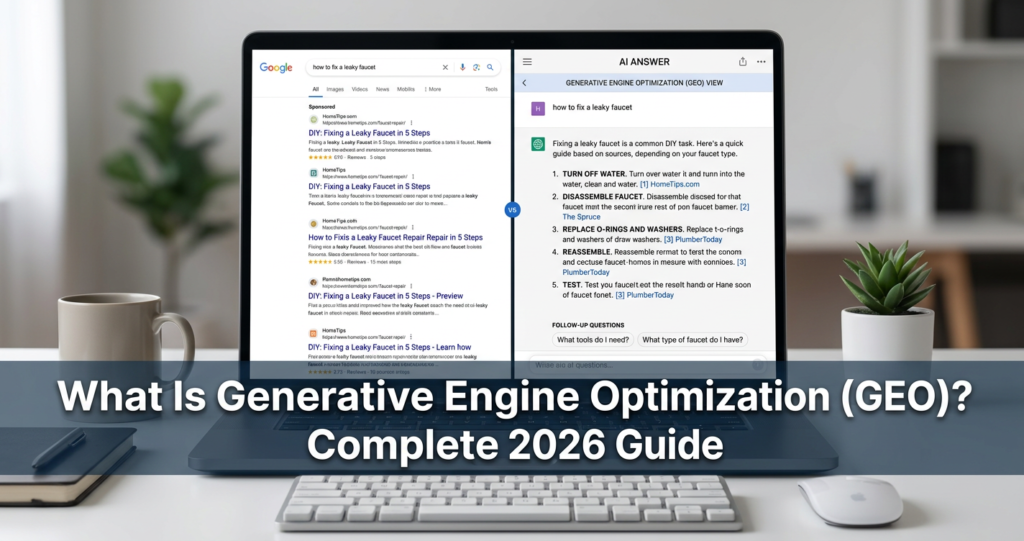
“Generative Engine Optimization (GEO) is the practice of optimizing your website, brand, and content so that AI-powered search engines, like ChatGPT, Perplexity, Google AI Overviews, Gemini, and Claude, cite your business when answering user queries.”
It’s how you become visible in the AI-generated answers that are replacing traditional search results.
Where traditional SEO focuses on ranking your website on the Google search results page, GEO focuses on getting your brand mentioned inside the AI-generated summary that often appears above those results, or inside the conversational answer that ChatGPT or Perplexity gives directly to the user.
The two work together. But the strategies are different.
Why GEO Matters Right Now (Especially in UAE & GCC)
Here’s the shift that’s happening, and why ignoring it is risky.
Traditional Google searches have been gradually disappearing without a click. According to a 2024 SparkToro zero-click study, 58.5% of Google searches now end without the user clicking through to any website. The user gets their answer directly from Google’s AI Overview, “People Also Ask” boxes, or featured snippets.
Meanwhile, ChatGPT alone now handles over 1 billion queries per day as of late 2024, with web-search capabilities pulling in citations from real websites. Perplexity, Claude, and Gemini are each adding millions of daily users who are using AI as their primary research tool.
For UAE businesses, this matters in three specific ways:
First, the buyers are younger and more AI-native. Dubai’s professional class skews young and tech-forward. They’re early adopters of ChatGPT and Perplexity for B2B research, restaurant recommendations, service provider comparisons, and travel planning. By the time you notice your competitors getting cited in AI answers, you’ve already lost months of potential leads.
Second, GCC English-language content is undersupplied. Most AI-cited content for “best [service] in Dubai” or “top [provider] in Abu Dhabi” still pulls from generic global sources or thin UAE listings. A well-optimized GEO strategy from a Dubai-based business can dominate these queries because the competition is genuinely shallow.
Third, traditional SEO competition is brutal in Dubai. Ranking #1 on Google for “SEO services Dubai” requires years of authority building. But getting cited in ChatGPT’s answer to “who is the best SEO consultant in Dubai”, that’s achievable in 60-90 days with the right approach.
How GEO Is Different From Traditional SEO
This is where most consultants get confused. Let me break it down clearly.
Traditional SEO optimizes for ranking on a search results page. The goal is to appear in the top 10 blue links when someone searches Google. The signals include keyword optimization, backlinks, on-page content, technical SEO, and Core Web Vitals.
GEO optimizes for being cited inside an AI-generated answer. The goal is to appear as a named source, recommendation, or reference inside the response from ChatGPT, Perplexity, Gemini, or Google AI Overviews. The signals are different, they include brand authority, citation patterns, content clarity, factual accuracy, and the existence of corroborating mentions across the web.
Here’s the practical difference:
| Factor | Traditional SEO | GEO |
| Primary goal | Rank on Google SERP | Get cited in AI answer |
| Key signal | Backlinks + keywords | Brand mentions + citation patterns |
| Where you appear | Below the AI answer | Inside the AI answer |
| Click required | Yes, user must click your link | Sometimes, user may just read the AI answer |
| Time to results | 6-12 months typical | 60-90 days possible |
| Measurement | Rank tracking + traffic | AI citation tracking + brand mentions |
This doesn’t mean traditional SEO is dead. The two strategies feed each other, a well-optimized website is necessary for both. But GEO requires you to think differently about which signals matter.
How AI Search Engines Decide What to Cite
To rank in traditional Google search, you optimize for Google’s algorithm. To get cited by AI engines, you need to understand how large language models (LLMs) decide what content is trustworthy and citation-worthy.
Based on research published by Princeton, Georgia Tech, and Allen Institute for AI (the team that coined the term “GEO”), AI engines weight several factors when deciding which sources to cite:
1. Authoritative quotation and statistics. Pages that include specific, verifiable numbers and quoted authoritative sources get cited more often than pages with vague claims. “58.5% of searches end without a click” is more citable than “many searches end without clicks.”
2. Brand mentions across the open web. AI engines don’t just look at your website. They look at how often your brand is mentioned, discussed, and reviewed across Reddit, Quora, industry publications, news sites, podcasts, and forums. A brand mentioned 50 times across diverse sources beats a brand mentioned once on its own website.
3. Clear, structured content. AI engines parse content the same way humans skim it, looking for headers, bullet points, direct answers, and clear definitions. Walls of text underperform structured content. The same applies to FAQ schema markup, which gives AI engines explicit question-answer pairs to cite.
4. Topical authority. Sites that cover a topic in depth (multiple pages, internal linking, comprehensive coverage) outrank sites that mention a topic once. This is the pillar-cluster strategy applied to AI search.
5. Recency for time-sensitive topics. For “best [X] in 2026” queries, AI engines prefer fresh content over older articles. Date stamps in URLs, “last updated” markers, and recent statistics signal current relevance.
6. First-party expertise signals. AI engines preferentially cite content that demonstrates real expertise, first-person experience, specific examples, professional credentials, and original analysis rather than rehashed generic content.
The 7 Core GEO Strategies That Actually Work
Here’s what I do for clients to improve their AI search visibility. This isn’t theory, it’s what’s working in 2026.
Strategy 1: Structure Content for AI Parsing
AI engines reward clear structure. That means:
- One direct, definitive answer to the page’s main question in the first 100 words
- Clear H2 and H3 headings that match how users phrase questions
- FAQ sections with question-answer format
- Bulleted lists for processes, options, or features
- Tables for comparisons
This GEO guide itself is structured this way intentionally. The “What Is GEO?” section delivers a direct answer immediately, in a paragraph format that AI engines can extract verbatim.
Strategy 2: Build Brand Mentions Across the Open Web
This is the biggest leverage point most consultants miss. Your website alone can’t make you a citable authority. You need your brand mentioned on:
- Industry publications (Search Engine Land, Search Engine Journal, Khaleej Times tech sections)
- Podcasts (UAE business podcasts, marketing podcasts)
- LinkedIn articles and posts
- Reddit threads (r/SEO, r/digital_marketing, region-specific subreddits)
- Quora answers (especially for UAE business questions)
- Industry directories and listings
Volume and diversity matter more than the authority of any single mention. Ten brand mentions across ten different sources beats one mention on a single high-authority site.
Strategy 3: Implement Proper Schema Markup
Schema markup is structured data that tells search engines and AI engines exactly what your content represents. The critical schemas for GEO are:
- `Organization` establishes your brand as a defined entity
- `Person` establishes the experts behind your brand as defined entities
- `Service` defines what services you provide
- `FAQPage` gives AI engines explicit Q&A pairs to cite
- `Article` for blog content, with proper author and datePublished properties
Google’s official Schema documentation covers implementation. AI engines now read Schema markup as a primary signal for entity recognition.
Strategy 4: Cite Authoritative Sources in Your Own Content
This sounds counterintuitive, but linking out to authoritative sources actually improves your AI citation likelihood. Why? Because AI engines have been trained on academic and journalistic content, where citations are standard. Content with citations is seen as more trustworthy.
When I write content for clients, I aim for 4-6 outbound citations per 2,000 words. Sources include Google’s official documentation, Search Engine Land, Moz, Ahrefs, peer-reviewed studies, and government statistics.
Strategy 5: Establish E-E-A-T Signals
Google’s E-E-A-T framework (Experience, Expertise, Authoritativeness, Trustworthiness) directly influences AI citation patterns. To strengthen these signals:
- Use first-person voice with specific experience claims (“In the SEO audits I’ve done for Dubai clients…”)
- Display author credentials, photo, and bio on every blog post
- Include date published and last updated stamps
- Show case studies, client logos, and testimonials where possible
- Link author profiles to LinkedIn, X, or professional credentials
Strategy 6: Optimize for Bing and Other Non-Google Engines
This catches most UAE SEO consultants off-guard. ChatGPT’s web browsing primarily uses Bing as its search index, not Google. If your site isn’t indexed and ranking on Bing, ChatGPT can’t easily find you.
Submit your sitemap to Bing Webmaster Tools, monitor your Bing rankings monthly, and don’t dismiss Bing as a smaller search engine, its results power a significant portion of AI search.
Strategy 7: Create Citation-Worthy Original Content
AI engines preferentially cite content that contains original insights, original data, or original frameworks. Generic content that summarizes other content rarely gets cited.
If you can publish even one original study, survey, or analysis per quarter, even something small, like “I audited 25 Dubai real estate websites in Q1 2026 and here’s what I found”, you create citation-worthy content that AI engines will return to.
Common GEO Mistakes I See UAE Businesses Making
After auditing dozens of UAE business websites in the past year, here are the patterns I see most often.
Mistake 1: Treating GEO as “AI keyword stuffing.”
Some consultants are now padding pages with phrases like “best in ChatGPT” or “AI-recommended business.” This doesn’t work, AI engines explicitly filter out this kind of self-promotional language. The fix: write naturally about what you actually do.
Mistake 2: Ignoring Bing entirely.
If your site doesn’t rank on Bing, ChatGPT can’t easily cite you. Most UAE SEO consultants don’t even verify their Bing Webmaster Tools setup. This is the easiest 30-minute fix that meaningfully improves GEO outcomes.
Mistake 3: No author identity on blog posts.
Blog posts with no author bio, no photo, and no credentials look like content farm content to AI engines. Adding an author profile with a photo, professional bio, and links to LinkedIn dramatically improves citation likelihood.
Mistake 4: Treating GEO as separate from SEO.
The most effective GEO strategies build on a solid SEO foundation. If your site has technical issues, broken schema, slow Core Web Vitals, or thin content, GEO optimization won’t fix those, and AI engines will still ignore your site.
Mistake 5: Optimizing only for ChatGPT.
ChatGPT gets the press, but Perplexity, Google AI Overviews, Gemini, and Claude each have different citation patterns. A balanced GEO strategy optimizes for all of them, not just one.
How to Measure GEO Success
Traditional SEO has rank trackers. GEO has its own emerging measurement tools, though the space is still maturing.
1. Direct query testing. Open ChatGPT, Perplexity, and Google AI Overviews. Search for queries your business should appear in (“best SEO consultant in Dubai,” “Shopify SEO services UAE,” etc.). Track which competitors get cited and where your brand appears (or doesn’t).
2. Specialized GEO tracking tools. Several tools have launched specifically for tracking AI citations, including Profound, AthenaHQ, Otterly, and Goodie AI. Most are subscription-based and aimed at marketing teams.
3. Brand search volume in Google Trends. If your GEO strategy is working, brand search (“Ask Best SEO Expert” or your business name) should rise over time as AI users hear about you in answers and then search for more information.
4. Direct traffic to brand URLs. Users who learn about you through AI search often type your URL directly rather than clicking a link. Watch your “direct” traffic in Google Analytics 4, sustained growth suggests AI visibility is working.
5. Referral traffic from AI sources. As of late 2024, Google Analytics 4 began identifying traffic from ChatGPT, Perplexity, and Gemini under the “Referral” channel. Monitor these for direct evidence of GEO results.
What I Recommend for UAE Businesses Starting With GEO
If you’re a Dubai or GCC business that wants to get serious about GEO, here’s the order I’d work through it.
Week 1-2: Audit current AI visibility.
Test 20-30 queries your business should appear in across ChatGPT, Perplexity, Gemini, and Google AI Overviews. Document which queries return citations, which competitors appear, and which entirely lack good UAE-specific answers.
Week 3-4: Technical foundation.
Submit your sitemap to Bing. Implement Organization, Person, Service, and FAQPage schema. Add author bios with photos and credentials to every blog post.
Week 5-8: Content depth.
Publish 2-3 pillar pages and 8-12 cluster blog posts on your core service areas. Focus on direct, structured answers to questions your buyers actually ask. Include citations to authoritative sources and original perspective from your experience.
Week 9-12: Brand mentions.
Begin earning mentions across diverse sources, LinkedIn articles, Reddit threads, Quora answers, industry directories, podcast appearances, guest posts on UAE/GCC business publications.
Month 4-6: Measure and refine.
Re-test your AI visibility queries. Identify which content is working. Double down on what’s getting cited; refine what isn’t.
This is the work I do with my consulting clients. It’s not magic, it’s systematic, structured optimization based on what we currently understand about how AI engines decide what to cite.
Frequently Asked Questions About GEO
Q. What does GEO stand for?
GEO stands for Generative Engine Optimization. It’s the practice of optimizing your website and brand to appear in answers generated by AI search engines like ChatGPT, Perplexity, Gemini, and Google AI Overviews, instead of (or in addition to) traditional search engine rankings.
Q. Is GEO the same as SEO?
No, GEO is related to SEO but optimizes for different outcomes. Traditional SEO targets ranking on the Google search results page. GEO targets being cited inside AI-generated answers. The two strategies complement each other and share some foundations (technical SEO, content quality, brand authority), but the specific tactics differ.
Q. Is GEO the same as AEO?
GEO and AEO are related but not identical. AEO (Answer Engine Optimization) focuses primarily on featured snippets, voice search, and “People Also Ask” boxes within traditional search engines. GEO is broader, focusing on citations inside fully generative AI responses from ChatGPT, Perplexity, Gemini, and similar engines. In practice, the two strategies overlap significantly.
Q. How long does GEO take to show results?
Most businesses see initial GEO visibility within 60-90 days of consistent optimization, compared to 6-12 months for traditional SEO. This is because AI engines update their citations more frequently than Google updates its rankings.
Q. Do I need to stop doing traditional SEO?
No, GEO builds on traditional SEO. A site with strong technical SEO, solid content, and good backlinks performs better in AI search than a site without those foundations. Think of GEO as the next layer on top of SEO, not a replacement.
Q. Can GEO work for small UAE businesses, or only enterprise brands?
GEO actually favors smaller, specialized businesses in undersupplied markets, including most UAE service categories. Because the competition for citation in AI answers for “best [X] in Dubai” queries is much thinner than competition for #1 Google rankings, smaller brands can gain disproportionate visibility through GEO.
Q. Does GEO work for non-English content?
GEO works best for English content because AI engines have been trained primarily on English text. Arabic-language GEO is possible but more limited. For UAE businesses, the most effective approach is publishing in English (which AI engines understand well) while ensuring brand presence in Arabic content elsewhere.
Q. How much does GEO cost?
Cost varies by scope. Most professional GEO consulting in UAE ranges from AED 3,000 to AED 25,000 per month, depending on whether you’re doing audit-only, partial implementation, or full strategic execution. The work involves content creation, technical implementation, brand mention building, and ongoing measurement.
Q. What tools do I need for GEO?
The minimum tools are: Bing Webmaster Tools (free), Google Search Console (free), Schema.org reference (free), and a basic AI tracking tool (Profound, AthenaHQ, or similar, usually paid). The bulk of GEO work is content strategy and execution, not tooling.
Q. Can I do GEO myself or do I need to hire a consultant?
You can absolutely start GEO work yourself if you have time and willingness to learn. The foundational work, schema implementation, content structure, Bing submission, is achievable independently. Most businesses bring in a consultant when they want strategic guidance on what to prioritize, faster execution, or measurement systems.
Why GEO Matters for UAE Businesses Right Now?
Here’s the honest truth about GEO in 2026: most UAE business owners I talk to are still treating it like a future trend, something to “look at next year.”
That’s a mistake. AI search has already crossed the line from emerging to mainstream. Your buyers are using ChatGPT and Perplexity today. They’re getting recommendations today. And the brands they’re hearing about today are the ones that started GEO work 6-12 months ago.
The good news: it’s not too late. The UAE market is genuinely undersupplied with quality GEO-optimized content. The Dubai SEO consultant who establishes citation patterns in AI engines now will dominate the next five years of how UAE buyers find services.
If you want to get started, the steps in this guide are real and actionable. You don’t need to hire anyone to begin. Audit your current AI visibility, fix the obvious technical foundation, publish citation-worthy content, and build brand mentions across diverse sources.
And if you’d like help with any of this, that’s what I do. I work with UAE and GCC businesses every week on exactly this kind of strategic visibility work. Reach out for a free GEO audit and I’ll show you specifically where your brand is and isn’t appearing in AI search answers, plus what would meaningfully move the needle.